Curing and drying oven Eurotherm BENELUX
Eurotherm BENELUX curing and drying ovens
Eurotherm BENELUX curing and drying ovens are designed to process parts after washing, liquid painting or powder coating. They ensure drying, polymerisation or stress relief depending on the industrial process required.
A key step in surface treatment
After preparation, washing or coating application, the oven stabilises the treatment applied to the part. This step directly influences the final quality, coating resistance and consistency of the result.
Eurotherm BENELUX ovens can be integrated into liquid painting lines, powder coating lines or installations dedicated to specific heat treatments.
Ovens for liquid painting and powder coating
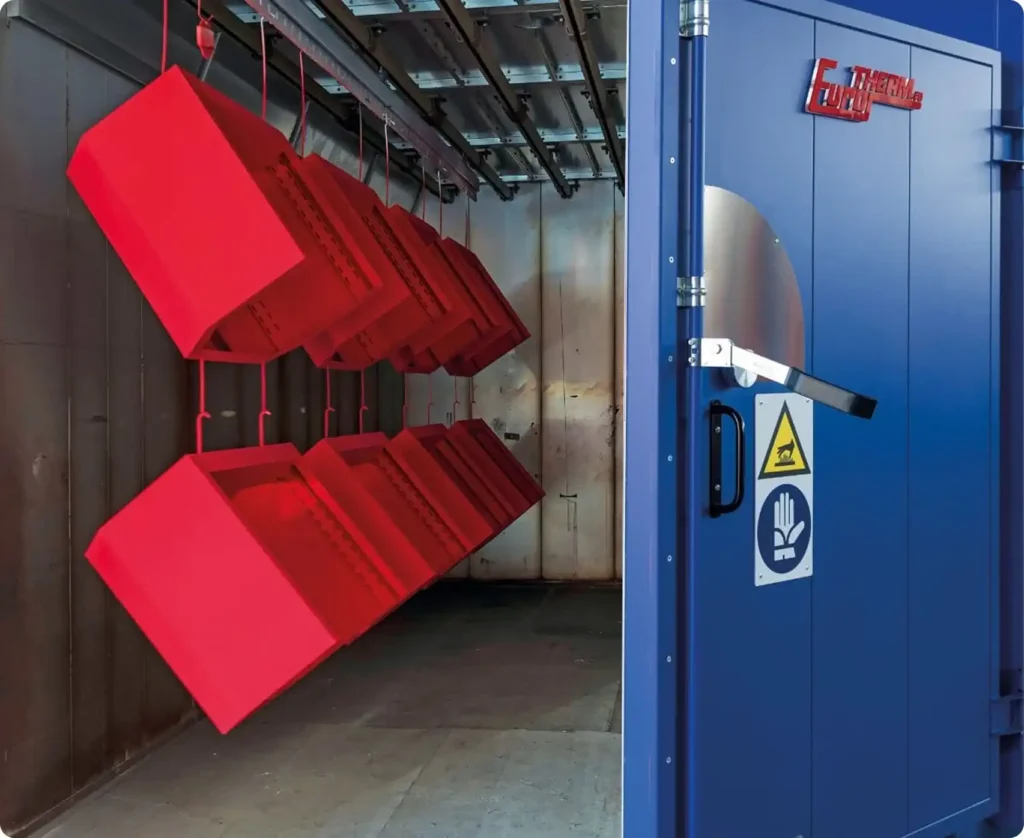
Depending on the intended use, curing and drying ovens are divided into several families. Ovens for liquid paint are mainly used for drying or desolvation. Ovens for powder coating ensure polymerisation of the coating.
The choice of oven depends on the type of paint, the temperature to be reached, the cycle time, the dimensions of the parts and the transport system used in the line.
Possible applications:
Drying of liquid paint
Desolvation before finishing
Polymerisation of powder coating
Heating of industrial parts
Stress relief of technical components
Special treatments according to the business sector
Custom-designed ovens
Eurotherm BENELUX designs ovens adapted to real production needs: dimensions, shape, temperature, heating technology, type of parts and production rate.
The ovens can be configured in different ways to meet workshop constraints and the expected level of control.
Available configurations:
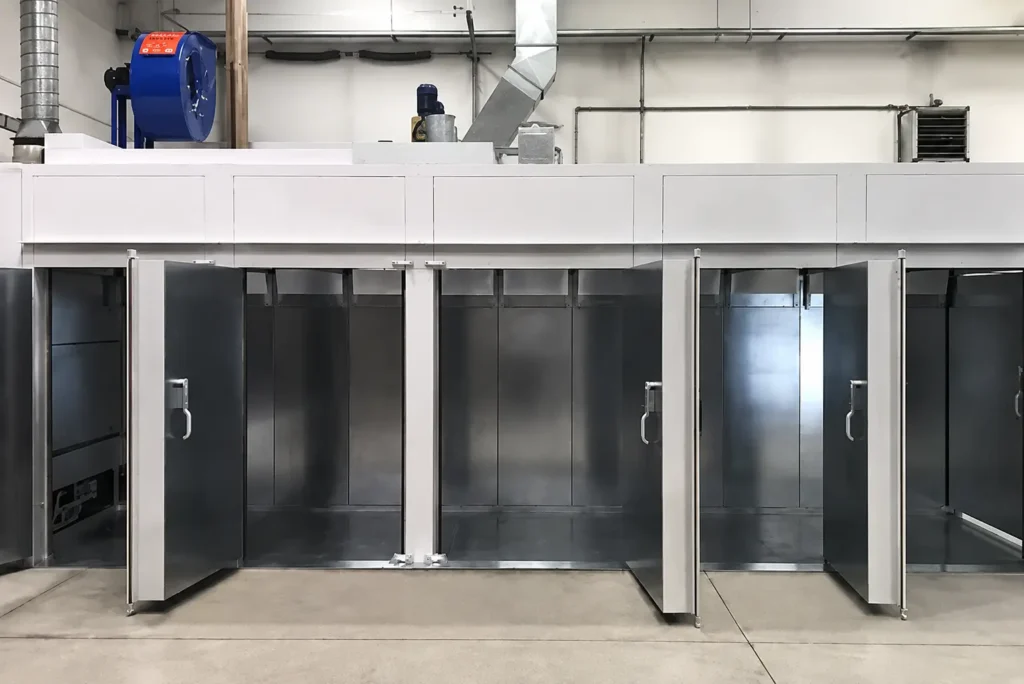
Static gas oven with two-leaf doors
Static gas oven with four-leaf doors
Pass-through oven with multiple access points
Factory pre-assembled electric oven
Oven with continuous belt conveyor
Continuous curing or drying tunnel
Temperature control and cycle consistency
An industrial oven must reach the required temperature and maintain it throughout the entire cycle. This stability ensures uniform treatment across all parts.
Depending on the application, Eurotherm BENELUX ovens cover ranges from 60 to 120°C for liquid paints, up to 250°C for powder coatings and up to 350°C for special treatments or stress relief.
Temperature control is carried out using a probe placed inside the chamber and a regulation system integrated into the electrical panel. Depending on project requirements, several probes or a graphic recorder can be added.
Key benefits:
Temperature regulated throughout the cycle
Uniform hot air distribution
Monitoring possible with several temperature probes
Adaptation to production requirements
Consistent result on treated parts
Direct exchange ovens
In a direct exchange oven, the burner flame is in direct contact with the air inside the curing chamber. This system is suitable for polymerising powder coatings and for certain water-based liquid coatings.
This technology offers fast temperature rise and economical operation depending on the available energy source.
Advantages:
Fast temperature rise
Solution adapted to powder coating
Economical operation
Use with natural gas, LPG or diesel
Indirect exchange ovens
In an indirect exchange oven, the flame remains isolated inside a combustion chamber. The treatment air is heated through contact with hot surfaces, without mixing with combustion gases.
This configuration is suitable for applications where the air in the chamber must remain separate from burner gases, especially for certain liquid paint treatments.
Key benefits:
Separation between process air and combustion gases
Solution adapted to specific liquid paints
Controlled drying process
Integration into a complete line
Electric ovens
Electric ovens use heating elements to warm the treatment chamber. They are often suitable for small production runs, smaller parts or applications requiring a compact solution.
Their monobloc design makes transport, installation and commissioning easier in the workshop.
Advantages:
Compact format
Factory pre-assembled solution depending on configuration
Simplified installation
Adapted to small series and specific production needs
IR tunnels and powder gelification
Infrared tunnels are used in continuous lines to quickly preheat the surface of the parts. They are used in particular for gelification of the powder coating before a second layer or final curing.
This solution can reduce the size of the main oven and reduce curing times in certain configurations.
Advantages:
Fast preheating of parts
Gelification of powder coating
Potential reduction in curing time
Integration into a continuous line
Ovens with continuous belt conveyor
Ovens with continuous belt conveyors move parts inside the oven throughout the entire process. They are suitable for heating or drying parts in specific applications.
This type of oven is used when the production flow must move forward in a regular and controlled manner.
Possible applications:
Drying of technical components
Continuous heating of parts
Treatment of small or medium-sized parts
Integration into an automated flow
Curing and drying tunnels
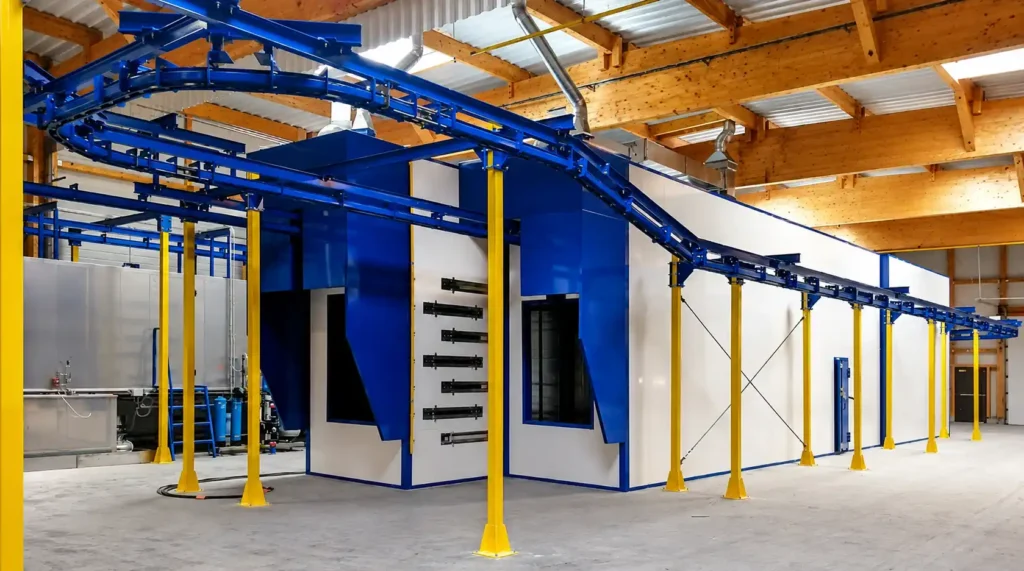
Drying tunnels are generally placed at the exit of washing tunnels. Curing tunnels are placed at the exit of liquid paint booths or powder coating booth.
Parts move through the tunnel using an automatic conveyor. The system can operate continuously or step by step depending on the process and expected production rate.
Continuous operation for regular production lines
Step-by-step operation with parking zones
Automatic doors depending on configuration
Integration after washing, powder coating or liquid painting
Energy savings and heat recovery
Eurotherm BENELUX ovens are designed to limit thermal losses and maintain stable temperatures over time. Hot air is recycled inside the chamber to ensure regular distribution with controlled energy consumption.
High-density mineral wool insulation and a design without thermal bridges contribute to the energy efficiency of the installation.
Key benefits:
Hot air recycling inside the chamber
Reduced heat losses
Insulation adapted to cycle temperature
Heat recovery depending on the installation
Uniform hot air distribution
Ovens for special treatments and stress relief
Some ovens are designed for specific treatments such as stress relief, aluminium ageing, heating of technical components or part treatment in the aerospace and automotive sectors.
These solutions are studied according to material constraints, temperature, cycle time and the expected level of precision.
Your curing and drying oven with Equindus
Are you looking for an oven to dry, polymerise or stress-relieve your industrial parts? Equindus supports you in the study, selection and integration of a Eurotherm BENELUX solution adapted to your activity.
Depending on your needs, we help you define the oven type, dimensions, heating technology, part transport method and integration into your production line.
FAQ about curing and drying ovens
What is an industrial drying oven used for?
An industrial drying oven is used to remove moisture, dry liquid paint or stabilise a part after washing or treatment.
What is a curing oven used for?
A curing oven is used to polymerise a powder coating. Heat transforms the applied powder into a solid, consistent and resistant coating.
What is the difference between direct and indirect exchange?
In a direct exchange oven, the flame directly heats the air in the chamber. In an indirect exchange oven, the flame remains isolated inside a combustion chamber.
When should an IR tunnel be used?
An IR tunnel is used to quickly preheat parts or gelify powder coating before a second layer or final curing.
Does Equindus support the choice of the oven?
Yes. Equindus supports professionals in choosing a Eurotherm BENELUX oven adapted to the parts, process, temperature and production volume.
← Back to the complete powder coating system
Manufacturer website: Eurotherm BENELUX curing and drying ovens
Product PDF: Eurotherm BENELUX drying and polymerisation ovens brochure